There’s a precise moment where WhatsApp sales fall apart. Not at the beginning, when the customer is still browsing. Not in the middle, when they’re asking questions. But at the end, when they’ve already decided to buy, and a payment link shows up.
That’s when they leave. Not because they changed their mind. Because you sent them somewhere else.
You don’t just lose the conversion. You lose the context. 3 out of every 10 people who try to pay you on WhatsApp don’t come back.
A payment link it’s a signal that the operation still lives outside the conversation.
From conversation to closed deal
Across Latin America, 92 % of internet users are already on WhatsApp. It’s where commercial relationships start, get resolved, and happen again.
Companies have learned to quote, recommend, and coordinate through chat. But the close kept living somewhere else. At Jelou, we started from a different infrastructure hypothesis: if the intent starts in the chat, the payment has to be able to happen there too.
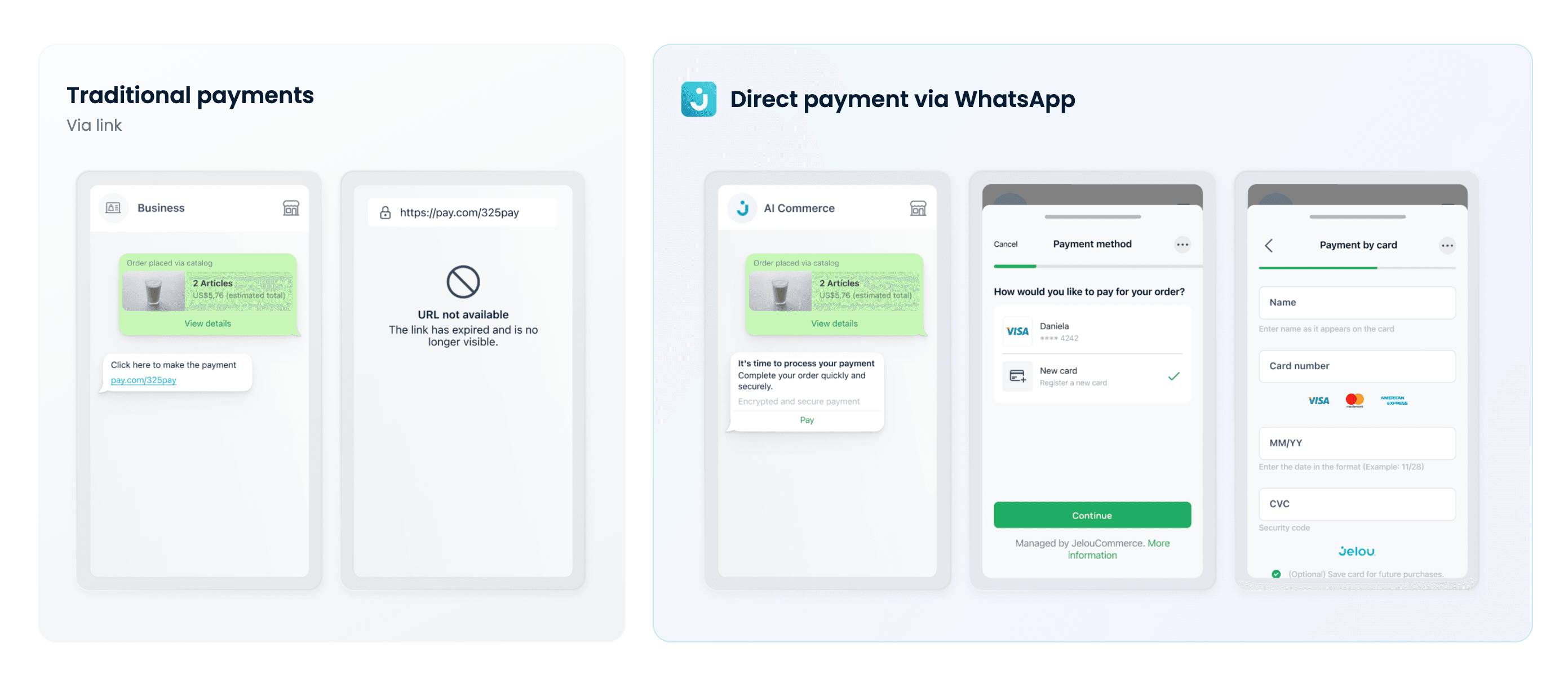
And this isn’t experimental commerce. Over the last four years, we’ve enabled conversational payments for hundreds of businesses. The data speaks for itself:
- 73 out of 100 transactions initiated in chat are completed without leaving the conversation
- 84 % year-over-year growth in payment volume
- $ 1.8 M processed in 2024, inside WhatsApp only
- $ 4.1 M processed in in-chat payments over the last four years
In traditional e-commerce, payment conversion rarely exceeds 50 %. In flows that depend on an external link, it can drop to 40 %.
When payment stops interrupting the sale
Kobe (one of Ecuador’s most popular upscale restaurant groups) activated native payments in WhatsApp and watched cart abandonment drop. Not because customers changed behavior, but because for the first time they didn’t have to leave the conversation to pay.
By integrating De Una and Nuvei (payment gateways) directly into their WhatsApp order flow, the payment became a native step in the checkout. Once the transaction cleared, confirmation and next steps continued automatically in the same conversation.
The pattern holds across industries. Retailers like Pycca and Falabella Colombia, CPG companies like Arca Continental (the world’s largest Coca-Cola bottler), and financial institutions like Banco Guayaquil and Banco Internacional already process sales, credit approvals, and collections inside WhatsApp, where Jelou has now crossed $120 million in total financial operations on its platform.
The gateways belong to the business
For any enterprise or regionally operating company, rebuilding payment infrastructure just to enable a new channel doesn’t scale. Every company already has locked-down reconciliation processes, bank relationships, and negotiated rates.
That’s why Jelou’s architecture runs on a Bring Your Own Keys (BYOK) model. Businesses connect their own payment infrastructure inside Brain Studio, from global coverage via Stripe and PayPal, to the local gateways that actually drive conversion in each market: Mercado Pago across 7 LATAM countries, Wompi in Colombia, Nuvei, PayPhone, De Una and Datafast in Ecuador, or Niubiz and Culqi in Peru.
If your business already works with any of these gateways, nothing needs to change. Jelou connects the infrastructure you already use directly to your WhatsApp conversational flow.
The account, the money, and the data stay with the business. The experience happens where the customer already is.
Isolated by design
Moving money inside a conversational environment has a clear technical challenge: AI engines and chat systems are designed to retain context and memory, the exact opposite of what secure financial data handling requires.
That’s why Jelou separates the conversational layer from the transactional layer at the architecture level. When a flow needs to capture card data, the AI model and any human agents are taken out of the input path.
The data never passes through the LLM, it travels encrypted and gets tokenized directly into an isolated vault. The agent never reads sensitive information; it only operates on tokens, webhooks, and reference states.
This architectural isolation is what allows us to operate under PCI DSS v4.0.1 SAQ-D and ISO 27001:2022 certification. Security isn’t a layer added on top. It’s part of how the system was designed.
Security and experience can’t be designed separately once a conversation starts moving money.
The payment isn’t the end of the flow
With more than $4.1 million processed exclusively in in-chat payments over the last four years, our biggest takeaway is this: the real value of a payment in chat doesn’t end with the charge.
When payment status returns to the same thread where intent was born, the operation stops being manual. If the transaction clears, the system automatically fires the invoice and pushes the order to logistics. If it’s declined, the AI instantly offers an alternative payment method, recovering a sale that in the traditional model would have died on an external link.
One integration moves the payment. An infrastructure keeps the context.
Latin America already lives and makes commercial decisions on WhatsApp. With the right infrastructure, the operation closes there too.
Build on this infrastructure
If you’re a developer:
Read the payments documentation: docs.jelou.ai/guides/integraciones/pagos/introduccion
Explore the full integrations catalog: jelou.ai/es/marketplace
If you run a business or enterprise:
Let’s talk about what this looks like for your operation: jelou.ai/es/#hs-meetings